GUIDES & SERVIES
VAT Registration
VAT Registration in Poland – Key Facts, Procedure and Tax Obligations
Entering the Polish market often requires obtaining VAT registration in Poland, particularly when a business plans to carry out taxable activities such as supplying goods or services. Although Polish tax law allows an entity to be considered a VAT taxpayer even without formal registration, in practice registration is essential to benefit from VAT deductions and refunds.
Understanding when VAT registration is required, how the procedure works and what obligations follow helps companies avoid delays and ensure compliance with Polish tax regulations.
Who Must Register for VAT in Poland?
VAT registration becomes necessary when an entity meets the definition of a VAT taxpayer and performs activities that fall within the scope of value added tax in Poland.
What Types of Activities Are Taxed Under Polish VAT?
According to the Value Added Tax Regulation, VAT applies to the following activities:
- supply of goods and services for consideration within the territory of the country
- export of goods
- import of goods
- intra-Community acquisition of goods for consideration
- intra-Community supply of goods for consideration
Entities performing such activities should register for VAT before carrying out the first taxable transaction.
Who Is Considered a VAT Taxpayer?
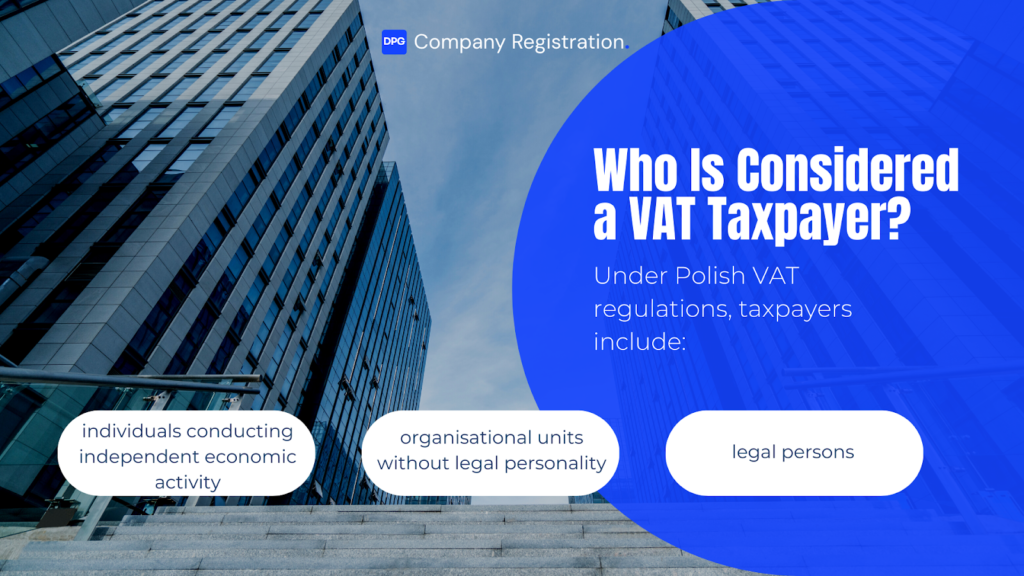
Under Polish VAT regulations, taxpayers include:
- legal persons
- organisational units without legal personality
- individuals conducting independent economic activity
The classification applies regardless of the purpose or the financial result of the activity.
When Should VAT Registration Be Completed?
In practice, VAT registration should be completed before the first taxable activity takes place. This may include:
- sale of goods
- provision of services
- opening a bank account related to business activity
Although an entity may still be recognised as a VAT taxpayer without formal registration, failure to register may prevent the taxpayer from using the right to deduct VAT or obtain a VAT refund.
If the taxpayer later completes formal registration and the right to deduction has not expired, it may still be exercised.
It is also important to note that VAT registration is not automatically performed during company incorporation. During the registration of a new Polish company, only the NIP tax identification number is assigned.
How to Register for VAT in Poland?
The VAT registration process in Poland requires submitting a specific tax declaration to the competent tax authority.
VAT Registration Procedure
The standard procedure includes the following stages:
- Preparation of required documentation
- Submission of the VAT-R registration form
- Possible inspection or verification by the tax office
- Entry into the VAT register
- Launch of VAT reporting obligations
The VAT-R application must be submitted to the tax office competent for the taxpayer’s registered office (for companies) or place of residence (for individuals).
How Long Does VAT Registration Take?
The duration of VAT registration in Poland depends on whether the application raises additional questions from the tax authority.
- If the submitted information is complete and clear, registration may occur immediately.
- In other cases, the tax office may request additional documentation.
As a rule, the procedure should not exceed 30 days, while in practice it usually takes between two weeks and one and a half months.
VAT Registration in Poland – Key Facts
| Aspect | VAT Registration in Poland |
| Application form | VAT-R |
| Where to submit | Competent tax office |
| Application format | Paper or electronic form (qualified electronic signature required online) |
| Processing time | Usually 2 weeks – 1.5 months |
| Office inspection | Frequently carried out during the process |
| Bank account required | Not required before registration |
| Virtual office | Does not allow VAT registration |
Supporting documentation typically includes:
- lease agreement or proof of ownership of premises
- incorporation documents
- foreign VAT number (if applicable)
- additional documents requested by the tax office
VAT-EU Registration for Intra-Community Transactions
Businesses carrying out transactions between European Union Member States must complete an additional VAT-UE registration.
This applies to activities such as intra-Community supply or acquisition of goods.
The VAT-EU status is obtained through the same VAT-R form used for standard VAT registration.
Taxpayers registered for VAT-UE must also submit separate VAT-EU declarations reporting intra-Community transactions.
VAT Rates in Poland
The Polish VAT system applies several tax rates depending on the type of goods or services supplied.
| VAT Rate | Application |
| 23% | Standard VAT rate (e.g. legal services) |
| 8% | Selected services including construction under social housing programmes, culture, sports and recreation |
| 5% | Basic foodstuffs, books and e-books |
| 0% | Intra-Community supply of goods and export of goods |
These rates determine the amount of output VAT included in invoices issued by the taxpayer.
VAT Exemption and Optional Registration
Certain taxpayers may benefit from VAT exemption under Polish law.
Two main exemption categories exist:
- individual exemption when annual sales do not exceed PLN 200,000
- subjective exemption when only VAT-exempt activities listed in Article 43(1) of the VAT Act are performed
Even when exempt, taxpayers may still voluntarily register for VAT or resign from the exemption.
If the taxpayer loses the right to exemption, a VAT-R application must be submitted before the date on which the exemption ceases or before performing the first taxable activity.
VAT Deduction Rules in Poland
A taxpayer may deduct VAT when several conditions are satisfied.
Conditions for VAT deduction
VAT deduction is possible when:
- the entity is a registered active VAT payer
- purchased goods or services relate to taxable activities
- the taxpayer possesses a document allowing deduction (for example an invoice)
- the expenditure does not concern items with limited deductibility
The deduction mechanism works by offsetting input VAT against output VAT.
- Input VAT – VAT included in the price of purchased goods or services
- Output VAT – VAT charged on invoices issued when selling goods or services
Registration before the first taxable activity is one of the conditions enabling VAT deduction.
VAT Returns and Reporting Obligations
Registered VAT taxpayers must submit periodic tax reports.
VAT declarations
VAT returns are filed electronically in one of two formats:
- JPK_V7M – monthly reporting
- JPK_V7K – quarterly reporting
The first declaration must cover the period in which the first taxable activity occurred.
VAT declarations must be submitted by the 25th day of the month following the accounting period.
Taxpayers registered for VAT-EU must also file VAT-EU declarations, submitted by the 25th day of the month following the month in which the tax obligation arose.
VAT Refund in Poland
VAT refund deadlines depend on the taxpayer’s reporting situation.
| Refund type | Deadline |
| Standard refund | 60 days after submitting the VAT declaration |
| Extended refund | 180 days if no sales were reported |
| Accelerated refund | Possible under statutory conditions if the refund does not exceed PLN 3,000 |
Deregistration from VAT in Poland
A company cannot directly cancel its VAT registration. However, it may be removed from the VAT taxpayer register when it ceases VAT-taxable activities in Poland.
The removal request must be submitted to the tax office within 7 days from the date on which activities ended.
VAT registration cannot be transferred between companies because each entity has its own tax identification number.
FAQ – Poland VAT Registration and VAT-R Form
What is the VAT-R form and when must it be submitted for Poland VAT registration?
The VAT-R form is the official VAT registration form used to notify the Polish tax authorities that a business intends to operate for VAT purposes. By submitting the VAT-R, a company or individual registers as an active VAT payer and receives a Polish VAT number linked to its Polish tax identification number.
The VAT-R should generally be submitted before the first activity that creates tax liability, such as selling goods or providing services subject to VAT under the Polish VAT Act.
Who qualifies as VAT payers under the Polish VAT Act?
According to the Polish VAT Act, VAT payers include legal persons, organisational units without legal personality and individuals carrying out independent economic activity.
These entities are treated as taxable persons when they perform transactions for VAT purposes, including supplies of goods, services, imports or intra-Community transactions involving EU countries or other EU countries.
What does it mean to become an active VAT payer in Poland?
An active VAT payer is a business that has completed Poland VAT registration and appears in the VAT register maintained by the Polish tax authorities. After registration, the entity must follow ongoing VAT compliance rules.
These obligations include maintaining VAT records, issuing invoices showing output tax, monitoring input tax, and filing Polish VAT returns according to the applicable reporting schedule.
What documents are usually required for the VAT registration process?
During the registration process, the taxpayer submits the VAT-R together with documentation confirming its business activity.
Typical documents include:
- incorporation documents of the company
- confirmation of the business address
- information necessary to obtain or confirm a Polish tax identification number
- additional documents requested by the Polish tax authorities
These documents allow the authorities to verify that the entity carries out genuine activity for VAT purposes.
Is a bank account required before submitting the VAT-R form?
A bank account is not strictly required to submit the VAT-R form and complete Poland VAT registration. However, having a local account is recommended once the company begins operations.
This is particularly relevant for:
- receiving VAT refunds
- making VAT payments
- operating within the split payment mechanism
A refund may not be transferred to a foreign bank account, which is why businesses often open a local account after registration.
What is the Polish VAT number and how is it used?
Once the registration process is completed, the taxpayer receives a Polish VAT number, which identifies the business for VAT purposes.
The number is used when:
- issuing invoices showing output tax
- reporting transactions in Polish VAT returns
- carrying out intra-Community transactions involving EU VAT
- confirming VAT status in official registers maintained by the Polish tax authorities
What VAT rates apply under Polish VAT rules?
The Polish VAT rates depend on the type of goods or services subject to taxation.
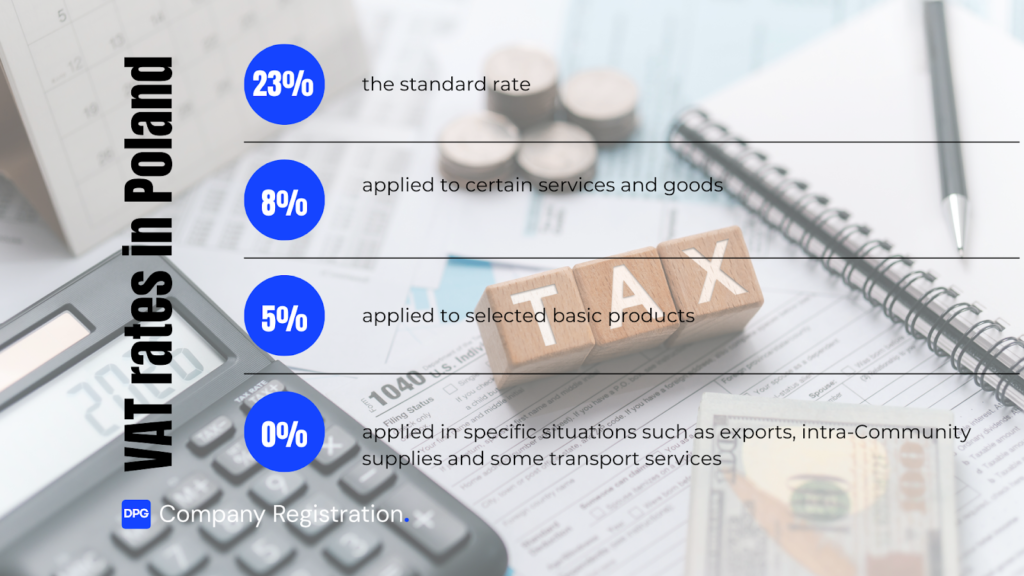
Common VAT rates include:
- 23% – the standard rate
- 8% – applied to certain services and goods
- 5% – applied to selected basic products
- 0% – applied in specific situations such as exports, intra-Community supplies and some transport services
The correct rate determines the amount of output tax that must be charged on invoices.
How does VAT deduction work for Polish VAT purposes?
The Polish VAT system allows businesses to deduct input VAT when certain conditions are met.
To recover VAT, the taxpayer must:
- be registered as an active VAT payer
- possess documentation such as an invoice
- use the purchased goods or services for activities carried out for VAT purposes
The deduction mechanism works by offsetting input tax against output tax generated from sales.
How and when must businesses submit Polish VAT returns?
Registered taxpayers must submit VAT returns electronically and maintain appropriate VAT records.
Reporting is performed using the standard audit file format and may be filed:
- monthly, or
- on a quarterly basis
The declaration must include the output tax, deductible input tax, and details of transactions carried out with EU countries or other EU countries.